
Below the floor
Crawl Space & Basement Insulation in Greenwood, IN
Warmer floors, drier air and a sealed rim joist for homes built on central Indiana's damp ground.
- Free estimates after we see the space
- Itemized written quotes with foam type, depth and R-value
- Moisture and air leaks checked before anything gets covered
Fixing What Is Under the Floor
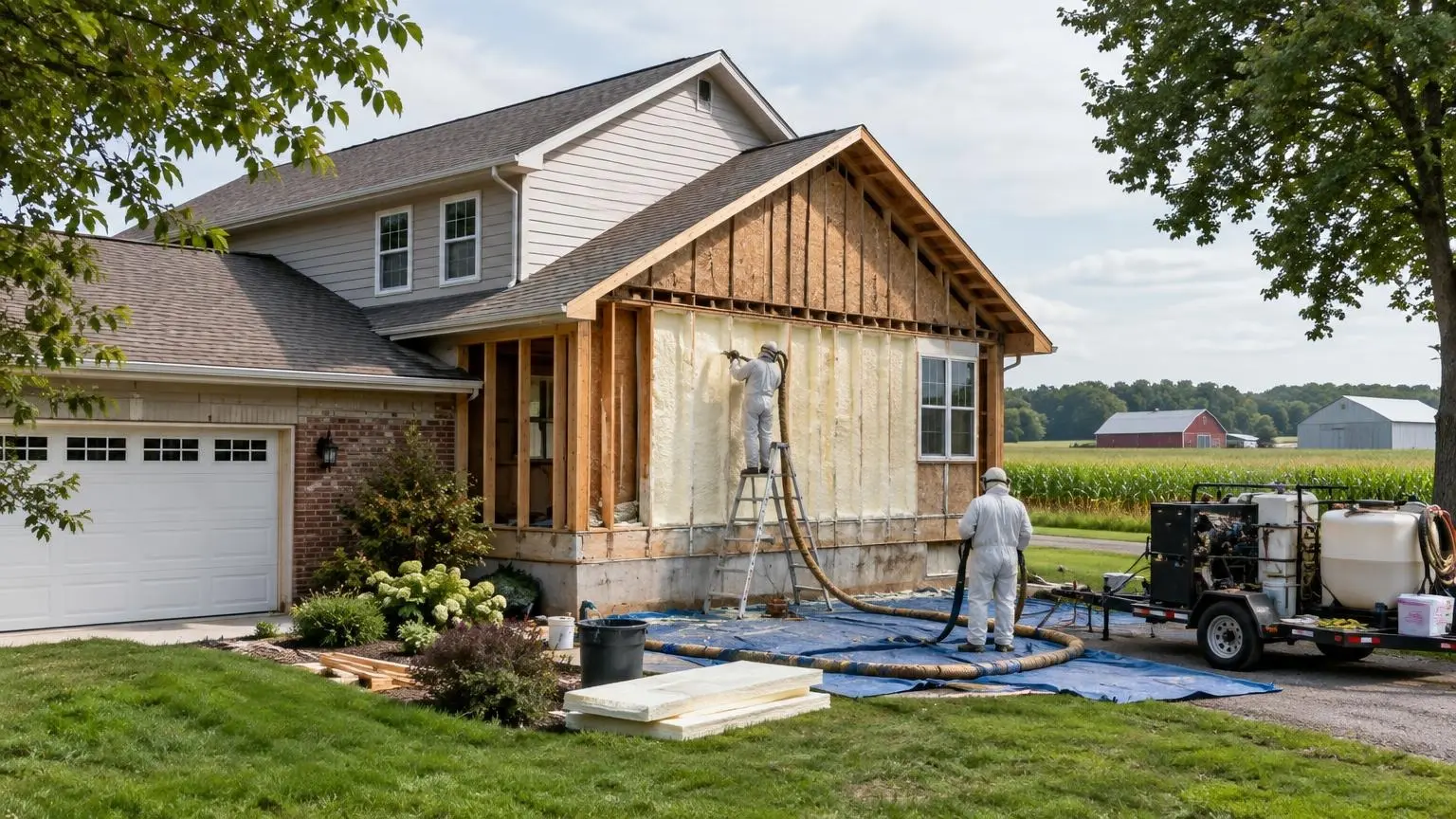
Crawl space and basement insulation targets the part of the house most people never see. In many Greenwood-area ranches and tri-levels the crawl space is vented to the outside, the floor above has sagging batts or nothing at all, and the rim joist that sits on top of the foundation is bare wood. The result is cold floors in winter, musty air in summer and a furnace and air conditioner that run longer than they should.
Why moisture matters here
The USDA describes Crosby soils, common on central Indiana's till plains, as somewhat poorly drained with a perched water table 0.5 to 2 feet down in winter and spring. Summers are humid. A vented crawl space pulls in moist July air, which condenses on cooler ducts, pipes and joists, while moisture also rises from bare dirt. That is how floor insulation ends up wet and falling down.
Closing the crawl space
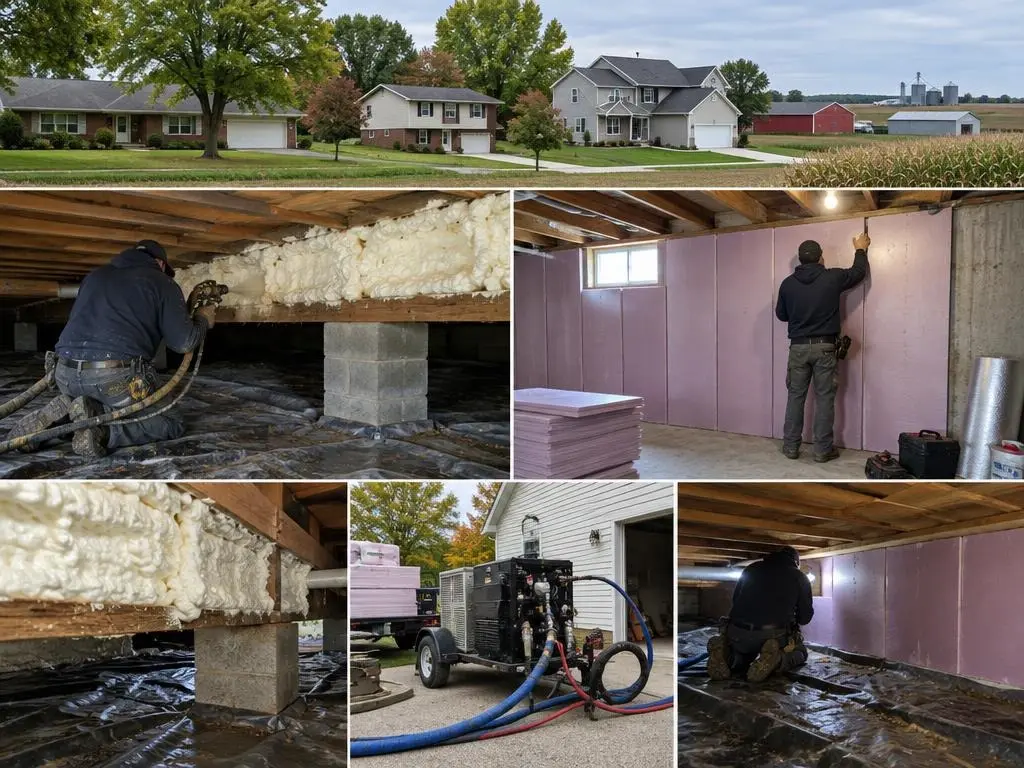
The usual fix is to treat the crawl space as part of the house. We lay and seal a heavy vapor barrier over the ground and up the walls, seal the vents and other openings where appropriate, and insulate the foundation walls and rim joist with closed-cell foam. The 2020 Indiana Residential Code lists R-13 or R-10 continuous for crawl space walls in Zone 5. Some homes need a dehumidifier or a small supply of conditioned air to keep the space dry, and we will say so in the quote.
Basements and rim joists
In basements, closed-cell foam on the rim joist seals one of the biggest air leaks in the house and insulates it in one step. Basement walls can be foamed directly or framed and insulated. The code value for Zone 5 basement walls is R-13 or R-10 continuous. Closed-cell foam is a good fit against concrete because it does not absorb water.
Drainage comes first
Insulation does not stop water. If we see standing water, efflorescence, gutters dumping at the foundation or grading toward the house, we point it out before quoting. Fixing those first protects the insulation and the framing.
What We Do Below the Floor
The pieces of a crawl space or basement job.
Vapor barrier and encapsulation
Sealed poly over the ground and up the walls, taped at the seams.
Vent and opening sealing
Closing foundation vents and gaps once the space is sealed.
Foundation wall foam
Closed-cell foam on crawl space or basement walls.
Rim joist foam
Sealing and insulating the band joist around the whole foundation.
Old batt removal
Pulling down wet or fallen floor insulation.
Dehumidification planning
Sizing a dehumidifier or conditioned air where the space needs it.
Published Crawl Space & Basement Insulation Costs
| Job | Range and source |
|---|---|
| Crawl space, spray foam | $2,000 to $4,000 (HomeGuide); $1,000 to $5,900 (Fixr) |
| Crawl space encapsulation | $3 to $10 per sq ft, $3,000 to $15,000 total (HomeGuide) |
| Vapor barrier only | $1,200 to $4,000 (HomeGuide) |
| Closed-cell on crawl space walls | $2 to $5 per sq ft (HomeGuide) |
| Sealing crawl space vents | $150 to $450 (HomeGuide) |
| Rim joists, spray foam | $2,000 to $2,500 (HomeGuide) |
| Closed-cell foam, installed | $3.00 to $5.00 per sq ft (HomeGuide) |
Sources: HomeGuide's 2026 spray foam and crawl space encapsulation guides and Fixr's 2025 spray foam guide. Wall height, the length of the rim, access, drainage and prep set the total, and the written estimate we give you is the price.
How a Crawl Space or Basement Job Works
1. Look for water
We check for standing water, damp framing, grading and gutter problems first.
2. Plan the space
We decide with you whether to close the crawl space and what the walls and rim need.
3. Clean out and barrier
Old batts and debris come out, then the vapor barrier is laid and sealed.
4. Foam walls and rim
Closed-cell foam goes on the foundation walls and rim joist to the specified thickness.
Why Choose Us for Crawl Space & Basement Insulation
Water before foam
Drainage problems are named before any insulation is quoted.
Code-level walls
We size wall insulation to at least the Zone 5 requirement.
Itemized pricing
Barrier, wall foam, rim and removal are separate lines.
Crawl Space & Basement Insulation Questions
Should I close my crawl space vents?
Often, but only as part of sealing and insulating the space. Closing vents without a vapor barrier and a plan for moisture can make things worse.
Is it better to insulate the crawl space walls or the floor above?
In a damp climate, insulating the walls and closing the space usually works better than batts in the floor, which tend to get wet and fall.
How much does it cost to insulate a rim joist?
HomeGuide lists spray foam on rim joists at $2,000 to $2,500. Length and access change the number, so we measure first.
Do I need a dehumidifier after encapsulation?
Some homes do and some do not. We look at the space and moisture levels and tell you in the quote.
Crawl Space & Basement Insulation Service Areas
- Spray Foam Insulation in Greenwood, IN
- Spray Foam Insulation in Franklin, IN
- Spray Foam Insulation in Whiteland, IN
- Spray Foam Insulation in New Whiteland, IN
- Spray Foam Insulation in Bargersville, IN
- Spray Foam Insulation in Trafalgar, IN
- Spray Foam Insulation in Edinburgh, IN
- Spray Foam Insulation in Southport, IN
- Spray Foam Insulation in Beech Grove, IN
- Spray Foam Insulation in Mooresville, IN
- Spray Foam Insulation in Martinsville, IN
- Spray Foam Insulation in Shelbyville, IN
- Spray Foam Insulation in Columbus, IN
Get a Crawl Space & Basement Insulation Estimate
We will check the space for water first, then quote the barrier, wall foam and rim joist separately.