
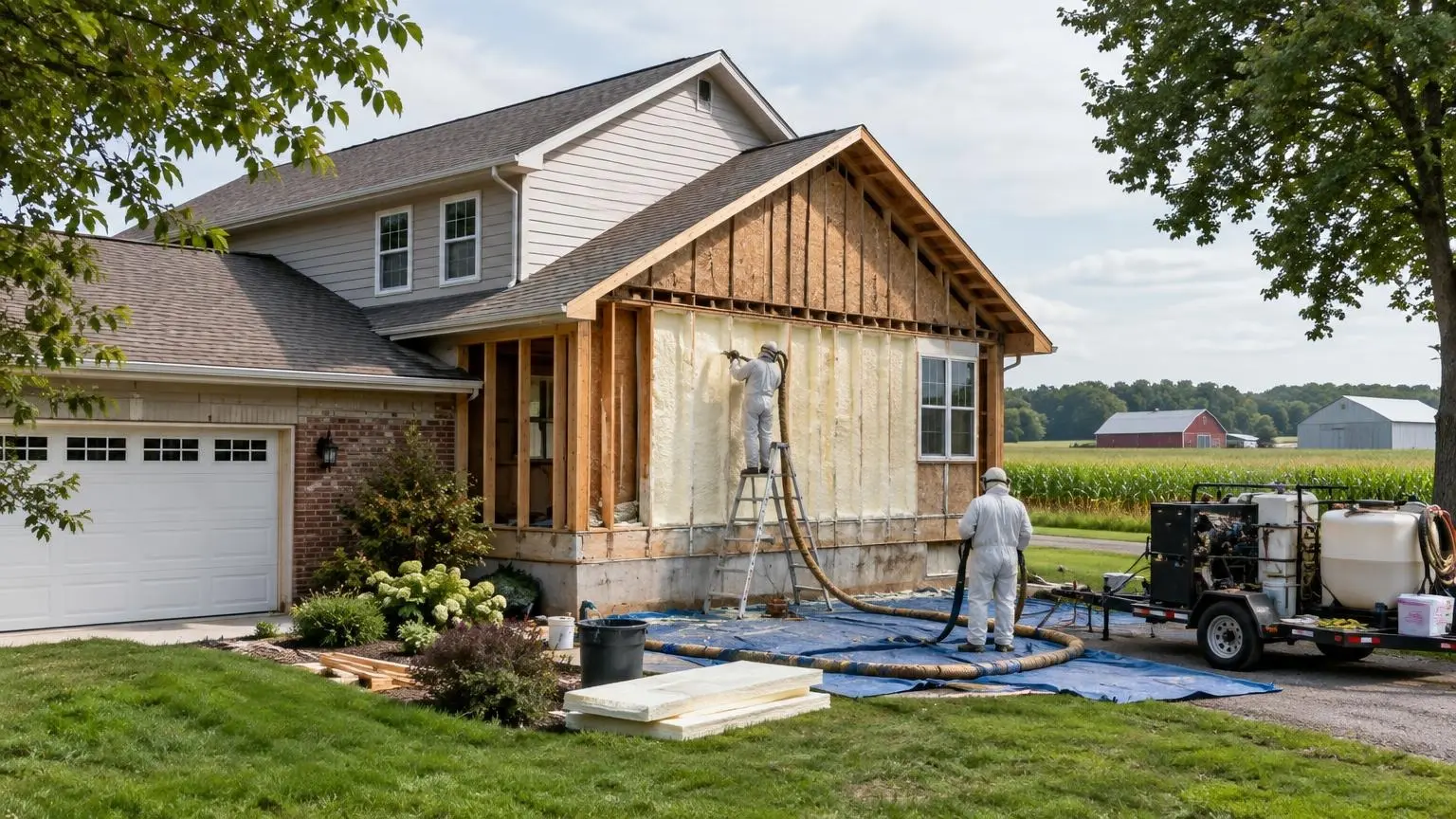
Cellulose and fiberglass
Blown-In Insulation in Greenwood, IN
The cost-effective way to bring an attic up to depth or fill closed walls, after the leaks are sealed.
- Free estimates after we see the space
- Itemized written quotes with foam type, depth and R-value
- Moisture and air leaks checked before anything gets covered
When Blown-In Insulation Makes Sense
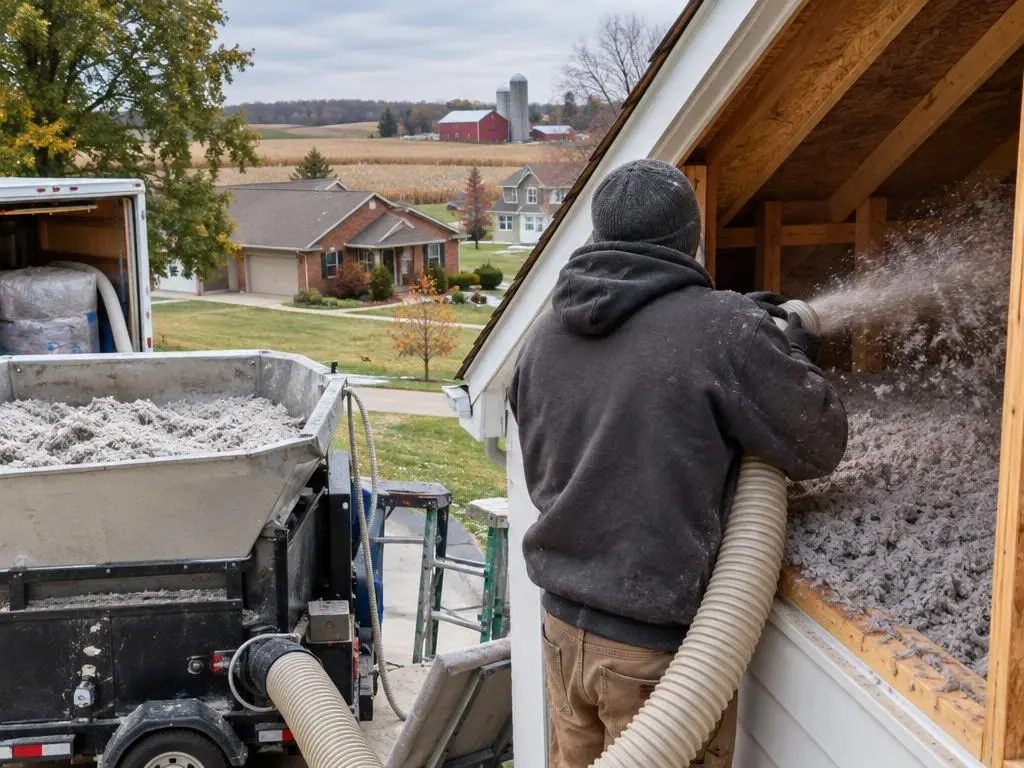
Blown-in insulation is loose cellulose or fiberglass blown through a hose into an attic or a closed wall. It fills around joists, wires and pipes better than batts and costs less per R than spray foam. For a standard vented attic in a Greenwood home, sealing the ceiling and then blowing loose fill to the right depth is usually the best value.
Cellulose or fiberglass
Cellulose is made mostly from recycled paper treated for fire resistance. It is dense and good at slowing air movement within the layer, and it is the usual choice for dense-packing closed walls. Blown fiberglass is lighter, does not absorb water and settles less. Fixr lists fiberglass at $1.65 to $2.60 per square foot and cellulose at $1.75 to $3.80. Either works well in an attic; we will explain why we suggest one for your house.
Reaching the right depth
The 2020 Indiana Residential Code lists R-38 for ceilings in Zone 5, and the Department of Energy suggests R-60 for an empty attic or adding R-49 over 3 to 4 inches. We blow to a depth that reaches the agreed R-value after settling and leave rulers in the attic so you can see it.
Air sealing first
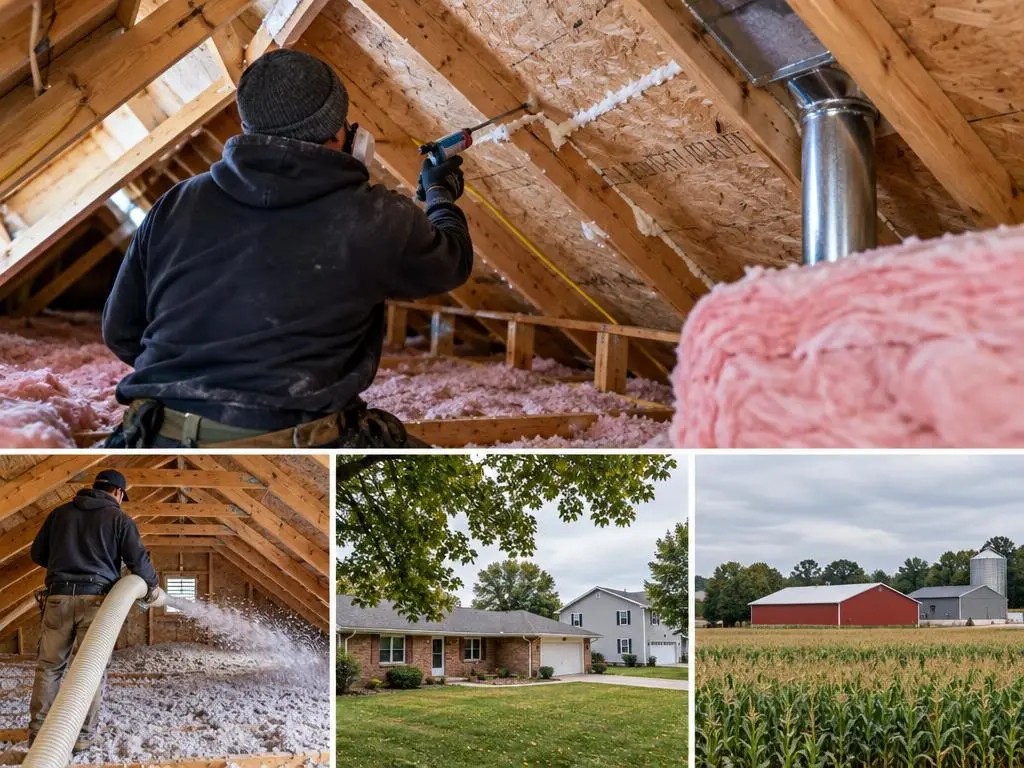
Loose fill does not stop air. Before we blow, we seal the gaps around lights, fans, pipes, wires and chases, install baffles at the eaves and weatherstrip the hatch. That step is what makes the new insulation perform the way it should.
Closed walls
In older homes with empty or partly filled walls, we dense-pack cellulose or fiberglass through small holes in each stud bay. HomeGuide lists blown-in wall insulation at $1,900 to $7,800 for a house.
When old insulation has to come out first
Most dry attic insulation can stay and be topped up. Material that is wet from a roof leak, matted by rodents, or mixed with old vermiculite is different. Wet or soiled insulation is removed before new material goes in, and vermiculite that may contain asbestos is left alone until it is tested and handled by a licensed abatement company. HomeGuide lists removal of old attic insulation at $1 to $2 per square foot. We note anything like that on the visit so it is on the quote, not a surprise on install day.
Garage attics and bonus rooms
Many Johnson County homes have an attached garage with an attic above it that connects to the main attic, or a bonus room over the garage with short attic spaces behind its kneewalls. Those spaces are easy to miss. We check whether the garage attic is open to the house attic, seal the wall between them where needed, and make sure the attic spaces beside a bonus room get insulated and sealed along with the rest.
Blown-In Services
Where loose fill works best.
Attic top-ups
Adding loose fill over existing dry insulation to the target depth.
New attic insulation
Full depth in attics that are empty or cleared out.
Dense-pack walls
Filling closed stud bays through small holes.
Air sealing
Sealing the ceiling before the insulation goes in.
Baffles and hatch work
Keeping vents open and sealing the access.
Garage attics
Insulating over attached garages and bonus rooms.
Published Blown-In Insulation Costs
| Job | Range and source |
|---|---|
| Blown-in, per sq ft | $1.00 to $2.80 (HomeGuide); $1.65 to $3.80 (Fixr) |
| Attic | $900 to $3,600 (HomeGuide); $1,750 to $5,500 for about 1,500 sq ft (Fixr) |
| Exterior walls | $1,900 to $7,800 (HomeGuide); $2,000 to $4,000 (Fixr) |
| Dense-pack cellulose | $1.60 to $4.20 per sq ft (HomeGuide) |
| Fiberglass / cellulose | $1.65 to $2.60 / $1.75 to $3.80 per sq ft (Fixr) |
| Typical job | $800 to $3,000 (HomeGuide); $3,000 to $7,000 (Fixr) |
National ranges from HomeGuide (November 2025) and Fixr (August 2025). Depth, attic access, sealing and any removal change your total. After the visit we give you a written estimate, and that is the price.
How a Blown-In Job Works
1. Measure
We check existing depth, condition and leaks.
2. Quote
Sealing and insulation are priced separately in writing.
3. Seal and baffle
We close the leaks and keep the eaves open.
4. Blow to depth
Loose fill goes in to the agreed depth with rulers left in place.
Why Choose Us for Blown-In Insulation
Lower cost per R
We use loose fill where it reaches the target for less than foam.
Sealed first
Air sealing is part of every attic job we recommend.
Depth marked
Rulers show the installed depth.
Blown-In Insulation Questions
Is blown-in insulation better than batts?
In attics, usually yes. It fills around obstacles and leaves fewer gaps. Batts work in open walls when they are cut and fitted carefully.
Does blown-in insulation settle?
Some, especially cellulose. We blow to a depth that still meets the target after settling.
Can blown-in go over old insulation?
Yes, if the old material is dry and clean. Wet or contaminated insulation should come out first.
How long does a blown-in attic job take?
Most take a few hours to a day, including air sealing.
Blown-In Insulation Service Areas
- Spray Foam Insulation in Greenwood, IN
- Spray Foam Insulation in Franklin, IN
- Spray Foam Insulation in Whiteland, IN
- Spray Foam Insulation in New Whiteland, IN
- Spray Foam Insulation in Bargersville, IN
- Spray Foam Insulation in Trafalgar, IN
- Spray Foam Insulation in Edinburgh, IN
- Spray Foam Insulation in Southport, IN
- Spray Foam Insulation in Beech Grove, IN
- Spray Foam Insulation in Mooresville, IN
- Spray Foam Insulation in Martinsville, IN
- Spray Foam Insulation in Shelbyville, IN
- Spray Foam Insulation in Columbus, IN
Get a Blown-In Insulation Estimate
We will check your attic or walls and quote sealing and loose fill in writing.