
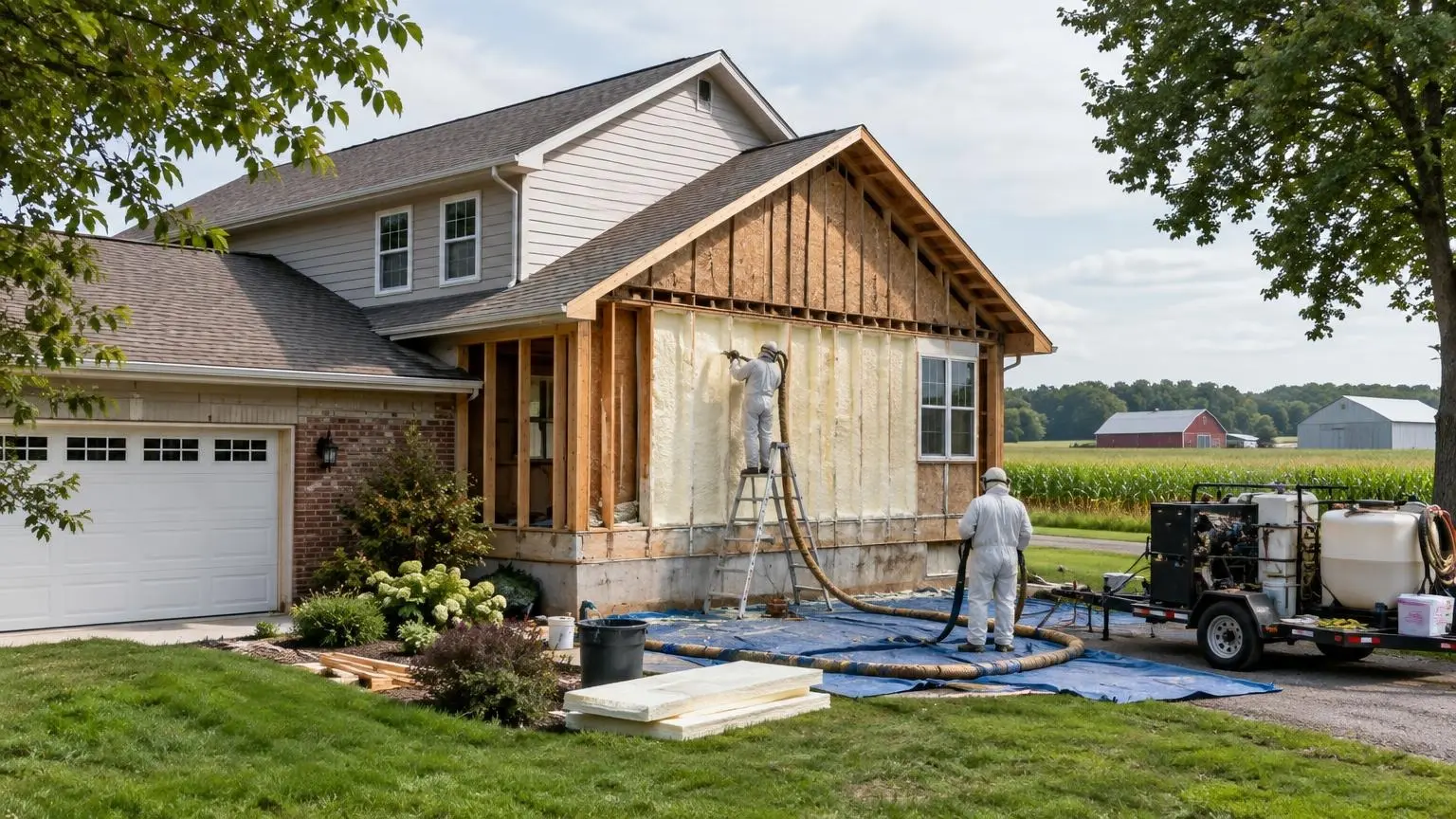
Homes, garages and pole barns across Johnson County
Spray Foam Insulation in Greenwood, IN
Stop the drafts, cold floors and sticky upstairs rooms that come with central Indiana weather, using foam where it earns its cost and loose fill where it does not.
- Free estimates after we see the space
- Itemized written quotes with foam type, depth and R-value
- Moisture and air leaks checked before anything gets covered
Spray Foam Insulation for Greenwood's Weather and Homes
Spray foam insulation in Greenwood has to hold up through a central Indiana winter and a muggy Johnson County summer. Wikipedia's climate figures for the city put the January mean low near 22.9F and the July mean high at 85.2F, with about 45 inches of rain and melted snow a year. A house that leaks loses heat for four months and pulls damp air into its attic and crawl space for another four. We find those leaks, close them, and insulate with open-cell or closed-cell spray foam where the surface calls for it and blown-in insulation where it gets the same result for less.
What Indiana code expects
OpenEI lists Johnson County, along with Marion, Morgan, Shelby and Bartholomew, in IECC Climate Zone 5A. The Insulation Institute's summary of the 2020 Indiana Residential Code, which took effect December 26, 2019, sets Zone 5 minimums at R-38 for ceilings, R-20 or R-13 plus R-5 for wood-frame walls, and R-13 or R-10 continuous for basement and crawl space walls. Those are floors for new work. For attics in existing homes the Department of Energy suggests R-60 when the attic is bare and an added R-49 where 3 to 4 inches already sit between the joists.
Where homes around Greenwood lose energy
Greenwood went from about 3,000 residents in 1950 to more than 63,000 in 2020, so its housing runs from postwar ranches near the old downtown to tri-levels from the 1970s and subdivisions still being built toward Bargersville and Whiteland. The older homes usually have a vented crawl space, an open rim joist and a thin attic. The tri-levels add a stepped rim, a family room on a slab and bedrooms over a garage. Newer homes have more insulation but leak at bonus rooms, attic hatches, can lights and the band joist. In every case the fix starts with air sealing, because insulation laid over a leak keeps leaking.
Closed cell vs open cell spray foam
Open-cell foam is light and soft. It fills a stud bay and stops drafts but lets moisture vapor pass, and HomeGuide rates it about R-3.5 to R-3.7 per inch. Closed-cell foam is dense and rigid at about R-5 to R-7 per inch, and at a couple of inches thick it slows vapor and does not soak up water. Around Greenwood that usually puts closed-cell on rim joists, crawl space and basement walls, shallow roof decks and steel buildings, and open-cell in walls, between floors and on some attic rooflines where moisture is handled another way. Your quote names the foam for each area and the reason.
Crawl spaces, basements and wet ground
Central Indiana's till-plain soils, such as the Crosby series, are described by the USDA as somewhat poorly drained with a perched water table 0.5 to 2 feet down in winter and spring. Add a humid July and a vented crawl space often stays damp: outdoor air comes through the vents and condenses on cool ducts and joists, and moisture rises from bare dirt. A sealed vapor barrier, closed vents and insulated walls usually keep it drier. In basements, closed-cell foam on the rim joist is often the single best dollar spent. We look for standing water and grading first, since no insulation fixes a drainage problem.
Spray foam insulation cost around Greenwood
HomeGuide's 2026 guide puts installed spray foam at $1.50 to $5.00 per square foot overall, $1.50 to $3.50 for open-cell and $3.00 to $5.00 for closed-cell. It lists rim joists at $2,000 to $2,500, crawl spaces at $2,000 to $4,000 and whole houses at $8,000 to $20,000, and notes that many installers set a $1,000 to $2,000 or higher job minimum. Fixr's 2025 figure for existing homes is higher, $3.15 to $7.50 per square foot. The square footage that matters is the surface we spray, not the size of the house, which is why we measure first. The written estimate is the price you pay.
Choosing among insulation contractors and companies
When you compare spray foam insulation contractors or general insulation companies near Greenwood, ask the same questions of each. What gets air sealed before insulation goes in? Which foam goes where, and why? What thickness and R-value are written down? How will attic and crawl space ventilation be handled? How long should everyone stay out after spraying (HomeGuide advises 24 hours or more)? What happens to old, damp or dirty insulation? Is the price split by area so two bids line up? If a search for spray foam insulation near me turns up a company that dodges any of those, keep looking. We answer each one in writing.
Utility rebates
AES Indiana's attic insulation rebate page lists $0.325 per square foot for attics starting at R-12 and $0.42 per square foot for attics at R-11 or less, brought up to R-49, for all-electric AES Indiana residential customers. Much of Johnson County is served by other utilities, and the page shows no dates, so check eligibility before the job. We can give you the measurements a rebate form asks for.
What We Insulate
Six services that cover the attic, the walls, what is under the floor and the outbuildings, each priced in writing after we measure.
Spray Foam Insulation
Open-cell and closed-cell foam for walls, rim joists, rooflines and crawl spaces, sprayed where it makes the biggest difference.
Learn more →Attic Insulation & Air Sealing
Seal the ceiling leaks first, then bring the attic up to the depth a Zone 5 home needs.
Learn more →Crawl Space & Basement Insulation
Close up damp crawl spaces, foam the rim joist and insulate basement walls so the floors above stay warm.
Learn more →Wall Insulation
Dense-pack blown insulation for closed walls and spray foam for open stud bays in additions and new builds.
Learn more →Pole Barn & Metal Building Insulation
Closed-cell foam on steel and wood framing to stop dripping condensation and hold heat in barns, shops and garages.
Learn more →Blown-In Insulation
Cellulose or fiberglass blown into attics and closed walls, a lower-cost way to reach the target R-value.
Learn more →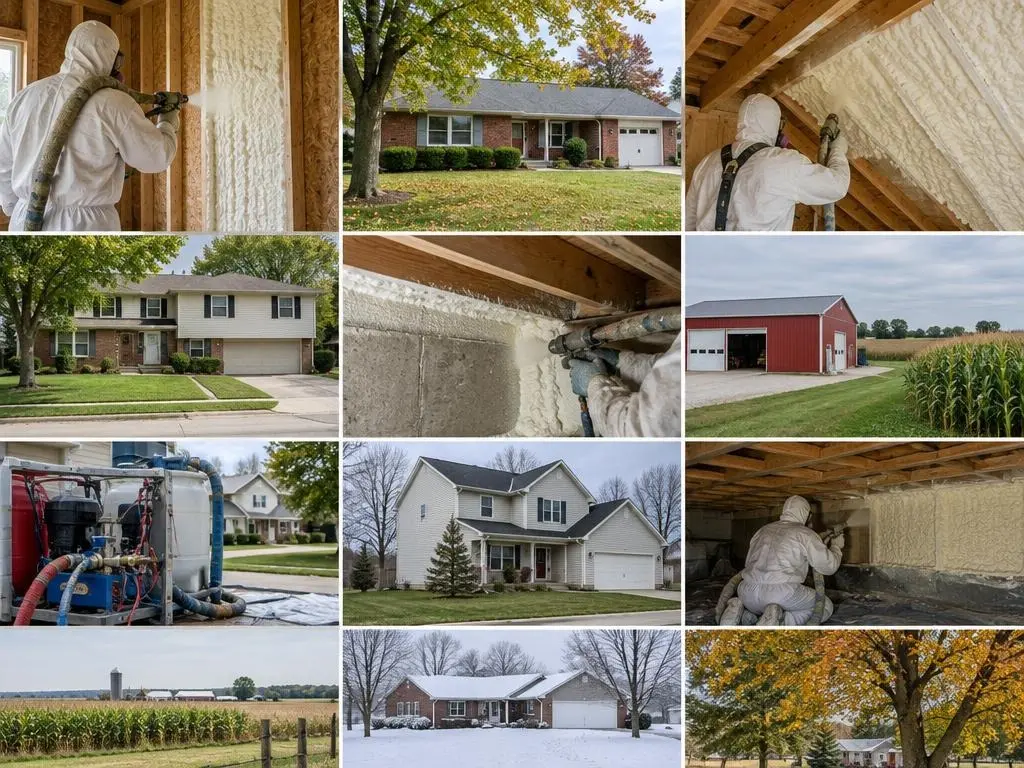
Where We Work
We work across Johnson County and the south side of the Indianapolis area. Greenwood, Whiteland, New Whiteland and Bargersville hold most of the newer subdivisions, along with older ranches near their town centers. Franklin and Edinburgh have older housing stock and creeks that flooded in June 2008, so crawl space moisture gets extra attention there. Southport and Beech Grove are compact, older south-side communities with set boundaries and mostly established homes. Farther out, Trafalgar, Mooresville, Martinsville, Shelbyville and Columbus mix town homes with farm ground, pole barns and shops. Each town page explains what is different about the homes and the ground there.
- Spray Foam Insulation in Greenwood, IN
- Spray Foam Insulation in Franklin, IN
- Spray Foam Insulation in Whiteland, IN
- Spray Foam Insulation in New Whiteland, IN
- Spray Foam Insulation in Bargersville, IN
- Spray Foam Insulation in Trafalgar, IN
- Spray Foam Insulation in Edinburgh, IN
- Spray Foam Insulation in Southport, IN
- Spray Foam Insulation in Beech Grove, IN
- Spray Foam Insulation in Mooresville, IN
- Spray Foam Insulation in Martinsville, IN
- Spray Foam Insulation in Shelbyville, IN
- Spray Foam Insulation in Columbus, IN
Why Homeowners Call Spray Foam Insulation Greenwood
Written, itemized quotes
Each area is listed with its material, thickness or depth, R-value and price, so bids can be compared line by line.
Air sealing comes first
We close the attic, rim and crawl space leaks before adding insulation, so the new material is not hiding the problem.
Foam only where it pays
Open-cell, closed-cell and blown-in each have a place. We recommend the one that fits the surface and the budget.
Moisture checked first
Standing water, damp framing and venting problems get flagged before anything is covered.
Common Questions
How much does spray foam insulation cost in Greenwood?
Published national ranges run $1.50 to $3.50 per square foot for open-cell and $3.00 to $5.00 for closed-cell (HomeGuide, 2026), and many installers have a job minimum of $1,000 to $2,000 or more. The total depends on how many square feet get sprayed and how thick. We measure and give you a written price.
Is closed cell or open cell better for an Indiana home?
It depends on the surface. Closed-cell suits rim joists, crawl space and basement walls and metal buildings because it is dense and resists moisture. Open-cell is a good value for walls and some rooflines. Many jobs use both.
Why is spray foam insulation now a red flag for some buyers and inspectors?
The concern is usually about foam sprayed on a roof deck in a way that hides leaks or rot, or about poor installs that leave odors. Those are installation and moisture questions, not a reason to avoid foam everywhere. We check the roof and framing first and explain where foam belongs and where it does not.
How well does spray foam insulate compared with fiberglass?
Per inch, foam is higher: about R-3.5 to R-3.7 for open-cell and R-5 to R-7 for closed-cell, by HomeGuide's figures. Its bigger advantage is that it seals air at the same time. On an open attic floor, sealing plus blown fiberglass or cellulose can match it for less money.
What R-value does my attic need in Johnson County?
The 2020 Indiana Residential Code lists R-38 for ceilings in Zone 5. For existing attics the Department of Energy suggests R-60 if there is nothing there now, or adding R-49 on top of 3 to 4 inches.
Do I have to leave the house when you spray?
Plan on it. HomeGuide advises staying out for 24 hours or more after spraying. We ventilate the work area and tell you when it is safe to come back.
Can you insulate a pole barn or detached garage?
Yes. Closed-cell foam on steel or wood walls and the roof cuts condensation and makes the building usable in winter. We check the building first and schedule around the temperature.
Do you do crawl space encapsulation?
Yes. We seal the vapor barrier, close the vents where it makes sense, and insulate the walls and rim joist. If there is a drainage problem we point it out before any work starts.
Get a Spray Foam Insulation Estimate in Greenwood
Tell us what feels wrong in the house. We will measure, explain the options and put the price in writing.